Flow, for me, is a specific mode of attention. It’s sustained, externally oriented, and lightly held. It depends on a certain looseness that’s hard to manufacture, and easy to lose.
Awareness of being observed alters that mode. The looseness goes. Attention turns inward. I begin evaluating rather than participating: monitoring myself instead of staying with what’s happening.
The shift is subtle but its effects are immediate. Flow doesn’t survive that shift. The moment attention is redirected toward how the work appears, the work itself recedes.
What brings it back isn’t reassurance or confidence. It’s forgetting: the brief moment when I stop tracking myself and the work takes over.
That forgetting feels like freedom. Fragile, but essential. It’s where the work actually happens.
I haven’t published anything here in a long time. Five years, give or take. Long enough that returning doesn’t feel like picking something back up… more like starting again, but differently. This post is an experiment in that return.
For a while the idea of writing publicly felt heavier than it needed to be. Anything I thought about posting carried an implied expectation: to be useful, to be coherent, to add something finished to the pile (particularly after co-writing and publishing a real-life book).
The years since 2020 have reshaped how many of us think about time, energy, and attention. A global pandemic, sustained uncertainty, and a steady accumulation of world-level disruption have recalibrated what we can hold, what we can sustain, and what we choose to give our focus to.
What’s shifted recently for me is less about confidence and more about permission. Permission to write without a clear endpoint. To let practice lead instead of outcomes. So I’m reframing this return as an experiment: provisional, bounded, allowed to be incomplete.
What changed in five years?
A lot, and not all of it cleanly. My work has deepened and I’ve come to value learning that doesn’t announce itself immediately. I’m less interested in declaring positions and more interested in noticing patterns as they form. I’m more interested in shaping conditions than directing outcomes. Practices that once felt adjacent – improvisation, reflection, systems thinking, creative experimentation – now feel connected, although the language to explain that convergence is still incomplete.
I’ve also learned how long things take. How rarely insight arrives on demand, and how often it shows up through repetition, presence, or simply staying with something longer than planned.
What am I intentionally not doing this time?
I’m not trying to turn this into a portfolio, a platform, or a promise of regular output. I’m not optimising for relevance, reach, or completeness. I’m not waiting until something feels fully formed before sharing it.
Instead, I’m treating this space as a record of practice. A place to follow threads, test ideas, and let some things remain unresolved. Some posts may be short. Some experiments may go nowhere. This now feels like a feature, not a flaw.
This is less a return to blogging than a way of making space for work, for curiosity, for what emerges.
With my thoughts increasingly turning reflective about the year gone by, one thing I am grateful for has been moving into the world of long-term thinking, specifically through my work on the University of Melbourne’s digital preservation strategy.
If you’re interested in reading more about the University of Melbourne project, I recently wrote a blog post version of a presentation for the Library Forum.
One of the biggest highlights for this year (and an excellent opportunity for personal growth) was presenting the university’s strategy at the iPres 2016 conference.
Being surrounded by the intelligence and passion springing out of the melting pot of minds that is the international digital preservation community at iPres was truly inspiring.
Although a tad narcissistic, my first foray into using Storify has resulted in a collection of stories of my own tweets from each session I attended at NLS7.
I’ve done this mainly for my own record and reflection in years to come, as this was my first sustained effort at live-tweeting an entire conference and I want to be able to measure if my style or method changes for future conferences.
What I like about live-tweeting is the ability to take on the role of a ‘citizen reporter’ for events like NLS7. My main goal was to provide a ‘flavour’ of each session I went to for those unable to attend the symposium and who were following the tweet stream from afar, by tweeting key points from each speaker, and also noting any pithy points that resonated for me.
What I continue to struggle with is the authenticity of live-tweeting, and not knowing whether a tweeter’s words are their own take on the situation or a direct copy of what they’re heaing. So when I live-tweet, am I putting my own spin on what I’m hearing, or am I typing quotes from the presenters verbatim, in order to best represent what the presenter intended? I suppose the more live-tweeting I do, the more I will cultivate my own voice, and those following along will in turn come to know this voice, and know what to expect. But what do I do about my continual fascination with playing devil’s advocate to explore many sides of an issue? By doing this, do I risk confusing people, or losing any trust that may be gained in my ability to correctly and without bias document events?
The interesting question as to whether live-tweeting without permission is unethical is explored by The Contemplative Mammoth (why did I not think of such a title for my blog?) and the idea that ‘it should be taken as a given that a tweet is not necessarily an accurate representation of what was said’ is noted. This I think is a nice point that gives those newer to the experience of live-tweeting a bit more confidence to experiment while finding their style or ‘voice’ for live-tweeting.
For me, live-tweeting at NLS7 was really an excellent way to connect with new peers in the industry, and to forge a Twitter Bond that will last long after the symposium, one that might even help assuage the #postconferenceblues that are in full swing.
As well, I feel that live-tweeting will in future become a public note-taking device for me – one where immediate broadcast can share my findings with many, many others and invite comment, debate, and further discussion.




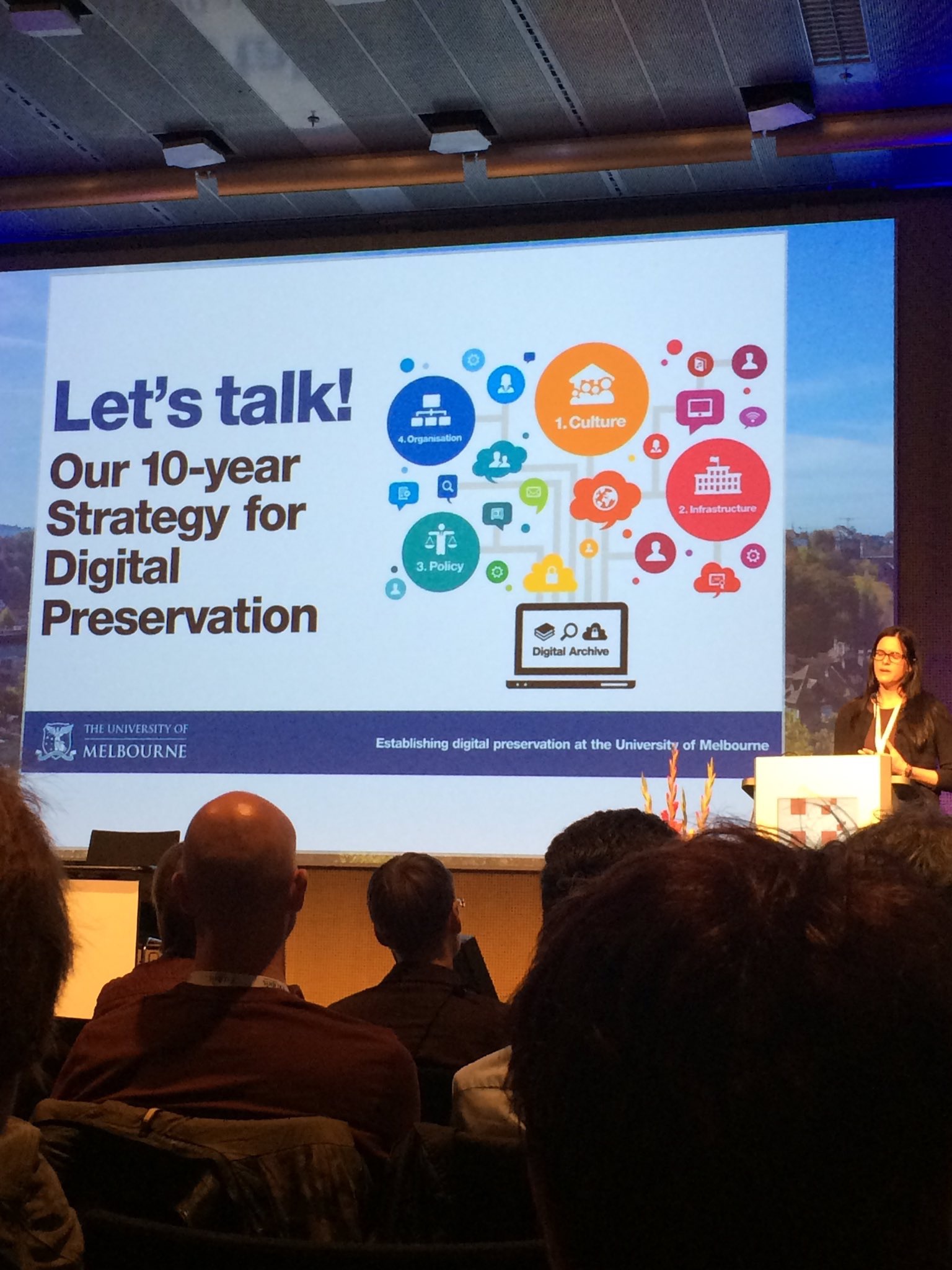 Being surrounded by the intelligence and passion springing out of the melting pot of minds that is the international digital preservation community at iPres was truly inspiring.
 Jaye Weatherburn