An Apprenticeship on Steroids: Preserving Digital Materials The Third

I was inspired to write this blog post thanks to New Cardigan’s Glam Blog Club October 2017 theme, “How I Ended Up Here”. When I saw the theme, I immediately thought: how did I end up co-writing a book, just a year after finally graduating from information management school? How did I get here? This post seeks to answer this question, and introduce a project I’ve been working on for the last year: a tome called Preserving Digital Materials (the third edition).

I am not a new professional in the strict sense of the phrase, having had a long-ish first career in television broadcasting. Writing the third edition of this book has been an apprenticeship on steroids – a great way to learn a lot about the important and exciting digital preservation field, in a very short time frame.

The short version of how I got here involves serendipity, luck, and perseverance. The perseverance part involved a meandering career change while still paying the bills with television work. I first studied teaching English as a foreign language, then professional writing, before settling on a Master of Information Management degree, with a lot of volunteering thrown in to help me best find my corner of the info universe. I love wrangling digital information, and I’ve always been fascinated by long-term thinking, so digital preservation is a perfect fit for me. As for serendipity and luck, one of my (many) volunteering gigs with the Australian Library Journal introduced me to then-editor Ross Harvey. When Ross was contemplating kicking off with the third edition of Preserving Digital Materials and looking for a co-author, I was in the right place at the right time. I was able to bring to the book different professional experience, and different ways of thinking – television is a colourful, competitive, and challenging world, with many transferable skills (collaboration and communication are two of the most immediate that come to mind).

The first two editions of this book were written by Ross. The first was based on interviews he undertook with Australian information professionals in the year 2005, thus it had a very national focus. The second edition in 2012 branched out further afield – it added various international projects and perspectives. It has been a fascinating experience, looking back over 17 years and seeing what has changed in the digital world – and what is still the same.
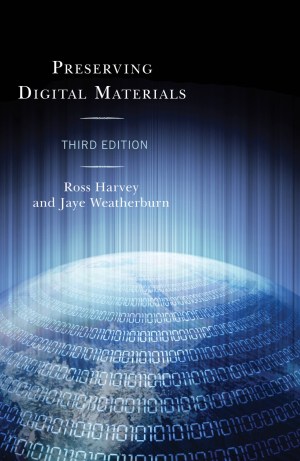
PDM3CoverThis third edition (to be published in March 2018 by US-based publisher Rowman & Littlefield) is an altogether different beast again. It has had a significant structural overhaul, and it is very internationally focussed. New stakeholders feature as a key focus, as digital preservation is no longer a niche area mainly of interest to cultural heritage institutions. New players are entering the scene and it is a welcome change, bringing many opportunities and also inevitable challenges. Initiatives such as International Digital Preservation Day from the Digital Preservation Coalition are increasingly publicly focussed, while still catering to the interests of traditional information organisations. Initiatives like these helpfully drive a positive digital preservation agenda to a wider range of people, and we have documented this changing paradigm in the book.

I very much hope this book is of use to both information professionals dealing with long-term management of digital materials, and others from different fields who are interested in learning more about the importance of stewarding digital materials into the future.

Another big thank you goes out to all my friends and family who put up with me during this process and are still hanging around. I promise one day soon I will have a social life again. Unless the fourth edition of this book needs writing a lot sooner than expected…

Engaging with our future: the role of educators, practitioners, professional associations and employing organisations in the co-creation of information professionals

In this article for the last issue of the Australian Library Journal LIS educators Sue Reynolds, Bernadette Welch, and Mary Carroll investigate a passion-based approach to student learning. Their vision of enabling new information professionals by cultivating in them ‘passion, engagement, and citizenship’ is a bold and welcome one. They consider the shared role of library and information studies (LIS) educators, practitioners, employing organisations and the professional associations in the development of LIS graduates and new professionals.

Exploring alternative models for professional LIS

In this article for the last issue of the Australian Library Journal, Brenda Chawner and Gillian Oliver aim to stimulate discussion about whether the current structure of postgraduate library education, largely unchanged for over sixty years, is still the best option, given the ways in which professional library positions increasingly require specialised knowledge and skills.

Brenda and Gillian touch briefly on the history of training for librarians in education before discussing the changing nature of library work today, offering alternative models for LIS education to meet this changing landscape.

New Professionals’ Perspectives (3 of 3)

In her paper for the last issue of the Australian Library Journal, Celia Drummond writes about diversity in the library profession (Embracing diversity: when is a librarian not a librarian?) and about using traditional library skills in non-traditional roles.

Celia argues that LIS educators should better showcase the wide range of roles in different sectors that are available to librarian-trained graduates.

New Professionals’ Perspectives (2 of 3)

In this article, Becoming a librarian: from Sydney to Hong Kong via a LIS degree, published in the last issue of the Australian Library Journal, Joanna Hare reflects on her personal journey to become a librarian, and on her first two years as one.

Jo shares the results of a brief survey of new librarians working in academic libraries in Hong Kong regarding their experiences of LIS education and first years in the profession, and concludes with some recommendations for other new librarians entering the workforce. She explains that although “Imposter Syndrome is a significant factor for all new librarians”, her journey has been successful because it has been based on learning by doing, and working outside her comfort zone.

New Professionals’ Perspectives (1 of 3)

In this paper, The new librarian’s roadmap: at the crossroads of expectation and reality, from the last issue of the Australian Library Journal (v. 65/4), Rebecca Dale provides a sobering view of some of the not-so-ideal stages of new librarian status, once the shiny excitement has worn off a little.

Rebecca’s travel romp journey details the formative years of a new librarian’s career trajectory, with a no-holds-barred look at different roadblocks along the way, such as “engine trouble” (using strategies that don’t pay off) and “potholes” (realising you’ve taken on the wrong job).

A big year in digital preservation

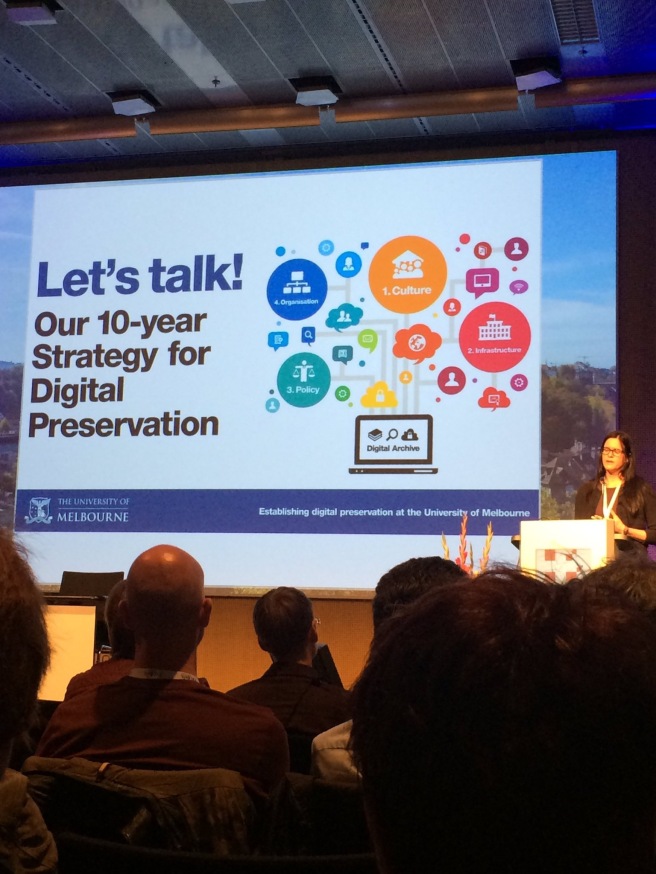
With my thoughts increasingly turning reflective about the year gone by, one thing I am grateful for has been moving into the world of long-term thinking, specifically through my work on the University of Melbourne’s digital preservation strategy.

If you’re interested in reading more about the University of Melbourne project, I recently wrote a blog post version of a presentation for the Library Forum.

One of the biggest highlights for this year (and an excellent opportunity for personal growth) was presenting the university’s strategy at the iPres 2016 conference.

jwatipres2016Being surrounded by the intelligence and passion springing out of the melting pot of minds that is the international digital preservation community at iPres was truly inspiring.

It was an exciting achievement to be voted in the top three poster presentations at the conference. The poster winners (Matthias Töwe, Franziska Geisser, and Roland Suri from ETH-Bibliothek, Switzerland) had an excellent contribution, To Act or Not to Act – Handling File Format Identification and Validation Issues in Practice.

And I was most impressed by the poster from my fellow runner-up Susan Braxton and her colleagues from the University of Illinois at Urbana-Champaign, whose project Should we keep everything forever? Determining long-term value of research data is one I’ll be following with much interest over the next few years.

Slack and dispersed community building #digitalhumanities

Today I came across an article in the LSE Impact Blog titled How the Digital Humanities are using Slack to support and build a geographically dispersed intellectual community.

We’re still figuring out how Slack can be useful: Can it allow different kinds of conversations than Twitter? Can we use it to teach and support people interested in DH who don’t have mentors geographically near them, or who aren’t inside academia? Like Twitter, Slack allows coexisting formal use (posting job opportunities, discussing theories) with informal socializing (which is really part of professional work, since it lays good foundations for future collaboration and problem-solving).

Dr. Amanda Visconti

It got me thinking about the digital preservation world and global communication channels. I’ve had great Twitter conversations that result in sometimes weird but fun things. I actively follow worldwide developments, events, and conferences online from afar here in Australia. I’m lucky this year to be attending iPres 2016 to present the University of Melbourne’s digital preservation strategy which means I’ll get to meet and talk with the international digital preservation community in person.

But what if there was a dedicated global online channel for digital preservation discussion, debate, and mentoring? A two-way discovery and sharing flow?

Dr. Visconti reports on interesting uses of the digital humanities Slack channel:

A user creating a channel around their specific research interests, and chatting in that channel as a sort of live-blog of the different approaches they’re trying and how they address issues as they arise (other Slack members can read or ask questions in the channel, too)
If an interesting discussion on Twitter starts to feel stifled or miscommunicated because of Twitter’s size constraints, moving the conversation to the DH Slack allows more freedom while also keeping the conversation semi-public (it’s more public than moving to an email conversation, but anyone wanting to follow the conversation does need to join the DH Slack first)
Mentoring and socializing: I’ve seen Slack members walk each other through fixing a coding bug or suggest lesson plans, and we use the #weeklies channel for weekly sharing around a fun theme (e.g. what’s a book that changed your way of thinking?)
A user sharing a digital humanities method tutorial, then offering to be available on the DH Slack for a certain evening to answer any questions about the tutorial (with the idea that people are encouraged to try working through the tutorial, knowing they will have help if they get stuck or have a question)

I’m wondering, does anything like this exist for the digital preservation community currently? And if it doesn’t, would it work? Would it flourish?

Participatory democracy #infuturemelbourne


Melbourne is projected to be a big city, so it should start thinking like a big city.

Dr George Quezada, Innovation Scientist


I’ve just completed day 1 (of 3) for the Future Melbourne 2026 Citizens’ Jury process. We on the jury are a bunch of 60-odd randomly selected residents and business owners of the City of Melbourne who are helping to deliver the third and final phase of the council’s Future Melbourne plan to 2026.

IMG_8290

This involves delving in detail into the report Future Melbourne 2026: Bringing your ideas together, and deciding on the final goals and principles to put forward to the six Future Melbourne Ambassadors to take to Council in August 2016.

I’m passionate about the future of this city, and wanted to be a part of this jury process to speak up from a library-loving, learning-focussed perspective. I’m interested in getting across the idea of needing good governance and planning in place for as-yet-unknown applications of new technologies throughout the city. I want to learn more about how to contribute to making this a sustainable city. Working in the information management world, I want to speak for sustainability of knowledge and information – particularly if there are to be improvements and increases in the partnerships between research organisations, government, and business, in order to drive innovative new projects.

The quote that opens this post is from guest speaker on day 1, George Quezada, an Innovation Scientist at Data61.

George noted that as people are able to access more information, and more data, about various processes that govern our everyday lives, and as they begin to analyse that data, those people will increasingly be able to challenge those in authority.

Transparency of information enables empowerment through increased knowledge.

George talked about the idea of establishing ‘future precincts’ in cities, and pointed to one example,  Samford Commons, which he is putting his energy into delivering after receiving substantial funding from The Moreton Bay Regional Council. The Samford Commons annual report from October 2015 expands the concept of their model in more detail.

Future precincts have captured my imagination: they are spaces that can’t be prescribed in advance; they must remain as free, constantly changeable spaces that will sow the seeds for new strategies to emerge to manage cities better. They must have the freedom to experiment with bold visionary ideas in a space that is conducive for careful failure. Samford Commons states that it will:

Host conferences, conduct accredited environmental management programs, sell natural produce, hold demonstration field days, conduct school programs, support sustainable industry co-working, manage a connection to the broader community and provide daily programs and innovative activities for businesses, schools, tourists, community members and on-line clients.


This is one way to tackle future challenges – for governments, councils, and citizens to be guided by the learnings and failings of these future precincts. As George put it, future precincts are demonstrations of a resilience strategy – providing outcomes from new modes of operating, these precincts may provide a means for a community to meet unexpected challenges. And it can be done much more effectively by utilising the strengths of all sectors – research, business, government, in increasingly connected ways.

Taking these ideas for the Galleries, Libraries, Archives, Museums, and Records (GLAMR) sector, wouldn’t it be great to have an information/cultural heritage voice in these future precinct spaces, for testing out new theories, ways of doing, ways of interacting with other sectors, and the community? Having true convergence and experimentation between sectors to learn from each other’s wins and fails?

The iGLAM research centre comes to my mind, the Laboratory for Innovation in Galleries, Libraries, Archives and Museums, as a prototype that could be put forward to begin to play in this wider space in partnership with government, business, and communities.

I was also reminded of the Innovation Study from 2014, Challenges and opportunities for Australia’s galleries, libraries, archives and museums, which clearly identified four strategic initiatives:

  1. Making the public part of what we do
  2. Becoming central to community wellbeing
  3. Beyond digitisation – creative reuse
  4. Developing funding for strategic initiatives

This report is an interesting read, particularly as various milestones for 2016 are detailed in it. And I’m also thinking a lot about how my voice on this jury can help further the agenda to ‘make the public part of what we do’ and especially how we can become even more ‘central to community wellbeing’.

Other notable things that stood out for me about my citizen jury experience:

Ben Rimmer, Chief Executive Officer of the City of Melbourne, spoke to us about the challenges around balancing the different needs of residents, business, students, visitors –and drilled into this further by explaining how difficult it can be to balance financing and resourcing for the basic everyday essentials that run a city, versus the ‘nice-to-do’ elements that enhance a city. He mentioned that the ‘nice-to-do’ extras that the City of Melbourne invests in are exactly the things that make Melbourne a great city. Another of Ben’s observations was that tech developments are coming ‘thick and fast’ to change the way our city operates (robots in the drains, location services technology placed in rubbish bins, autonomous cars not too far away now) – and his ‘professional guess’ that the next ten years will see technology change have the biggest implications for the city.

Maria Katsonis, Director, Equality, in the Department of Premier and Cabinet (Victoria), is one of the Future Melbourne Ambassadors. She spoke about the importance of workplaces allowing and enforcing an allowance of bringing your true, authentic self to work everyday. As she said to us, ‘two years ago, I wouldn’t have been wearing rainbow shoelaces to work’, pointing to her colourful laces. Maria spoke of Richard Florida’s The rise of the creative class, and how it raises the question, can you attract a certain type of person to a city?

Maria’s parting consideration for us was most interesting, as it echoed what I’d heard in a lot of the discussions during the day. When going through the report, and deciding and debating what’s in and what’s out, we should always be thinking: who’s excluded from this plan? Does it truly reflect the needs of our diverse community? Does everyone have a voice, a place in it?

Kate Auty, another of the Ambassadors, in response to my question wondering who the visionary leaders are in the sustainability sector that she looks to, that we can seek out – the change agents – she answered, ‘It’s all of you – you’re all leaders. Start where you are, and organise’. Her example of this idea in action came from her experience, being involved in a campaign seeking (successfully) to change some entrenched mindsets (a group of farmers) toward climate change.

This jury day was extremely intense. It was a day of testing assumptions, questioning, and learning.

For anyone considering a chance to participate in this kind of process in future, here are some select thoughts gathered from myself and others about our day, paraphrased:


Participatory democracy feels like proper governance, the way things should be.

There is a feeling of more investment already in the outcomes, over just one day – much more so than going to the ballot box and picking from a bunch of fixed policies.

Diversity is all about inclusivity.


It seems to me that participatory democracy is something that the community is hungering for: this two-way communication activity that has been offered to us has been accepted, and trust that the council will implement our work has been established.

This process is invigorating. At the end of day 1, I’m completely engaged with and addicted to citizen-led and citizen-influenced democracy.

The challenge for me on the next two jury days is to look beyond my priorities and areas of interest to see how they fit in with the bigger picture goals of this process – to refresh the goals of a city for the people, one that is creative, prosperous, full of knowledge, sustainable, and connected, and that reflects a bold and brave vision of what Melbourne could be in 2026.